


Special Exhibit:
The First Quadruplex
(Click on any of the images on this page to see a larger version)
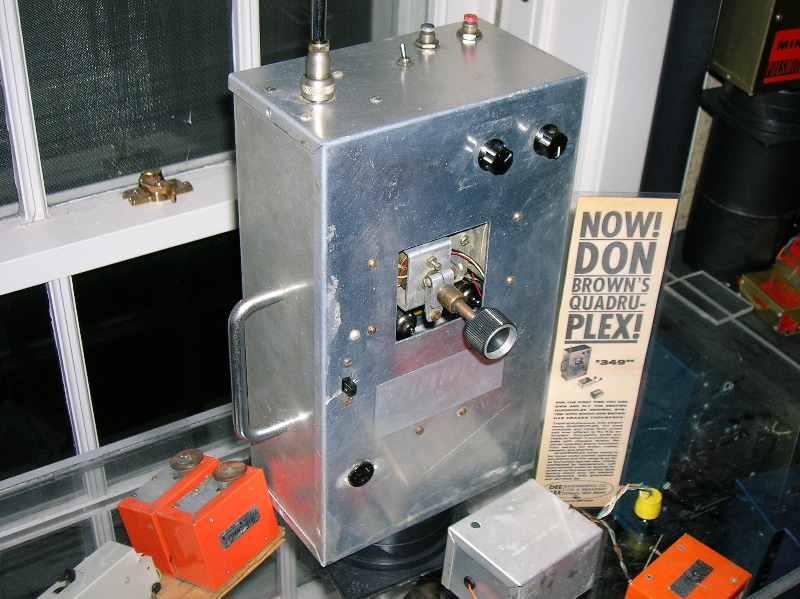
This is Don Brown’s prototype Quadruplex which he flew for months before any Quadruplex was manufactured or sold. Don hand-built this transmitter and receiver in the cellar of his house in early 1962. Carl Schwab, who designed the electronics, provided advice and assistance by phone; he also provided schematics, sheet metal layout sketches, some prototype PC boards, torroidal coil sets and coil forms. Don flew this system in the August 1962 Internationals in England and was in first place until his engine quit mid-flight. Were it not for that engine malfunction, radio control history would have probably been altered.
The Gas That Changed History
Don Brown’s engine failed twice that day in the 2nd and 3rd rounds of the competition. The press said his engine ran out of gas. Don attributes this fateful engine failure to his use of local (U.K.) fuel. He didn’t know that its different composition could cause clogging or otherwise lead to engine failure.
While the engine worked, his flights were so impressive and he racked up so many points, that he still won fifth place. This was a most remarkable accomplishment since it was achieved despite being unable to complete two rounds and receiving none of the possible points for each of the maneuvers which followed engine failure. Despite the great flying by Tom Brett (who ultimately won) and others with their reed systems, there can be little doubt but that Down Brown and his Quadruplex would have carried the day were it not for the engine failure.
What would this have meant? To put this in context, in August of 1962, Space Control was still striving for sales and Sampey had not yet introduced his 404. The Quadruplex system was exceptionally reliable and sold in relatively large numbers. It is difficult to predict how many more would have sold had he scored first in the internationals at a time when proportional was openly mocked by leading RC figures and not yet the heir apparent to the future of RC. The impact would have probably been quite large. The course of equipment development might have also been altered, for awhile at least, away from feedback systems and digital.
Here is a press account of one of Don’s flights that day:
“Once again the flight that everyone was now waiting for was Don Brown’s…Don went through half the pattern faultlessly and at maneuver no. 9, a roar went up from the crowd as he throttled back and his model performed the best and truest tail slide we had seen. Alas, when the noise of cheering and clapping died away, our worse fears were confirmed: the engine had stopped.”
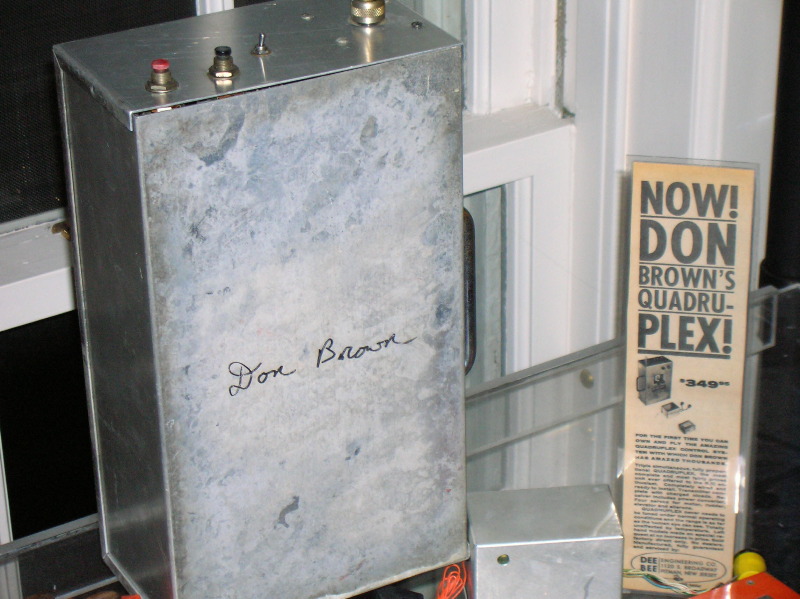
Don Brown autographed this transmitter before providing it to us and confirmed it was the “Mother of all Quadruplexes” which he flew in the 1962 internationals and then kept all these years. He didn’t tell us about its second distinction, however.
Magazine Model
This transmitter appears to be the actual model photographed for all of the first Quadruplex ads. Memories fade over time but Don Brown was also an accomplished photographer who shot his own equipment for ads. Perhaps the lead time for ad publication compelled him to use his prototype in the ads with no time to prepare a first production model. Were it not for the lower quality black & white / brown & white ads of that era it would not have been possible to pull this off.
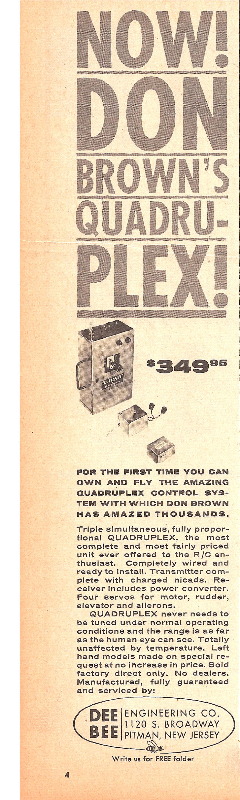
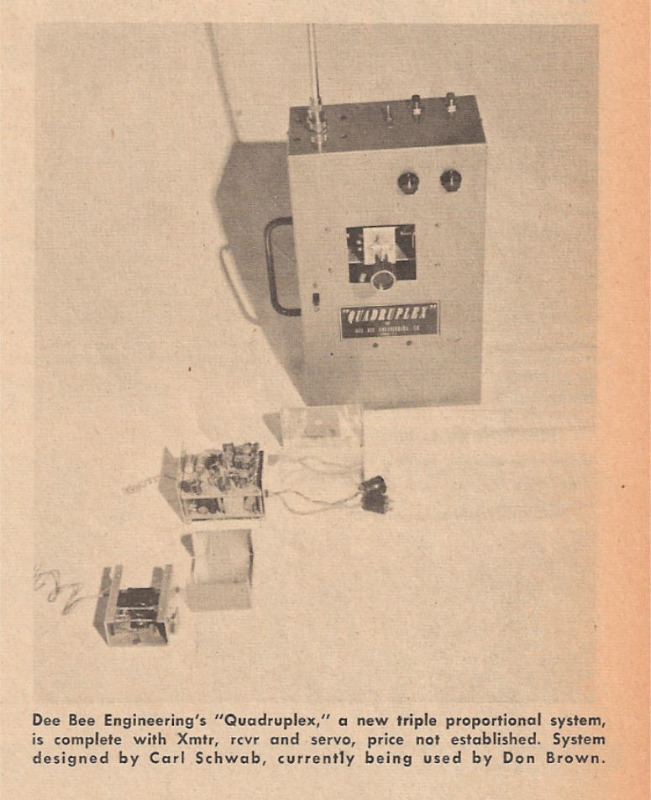
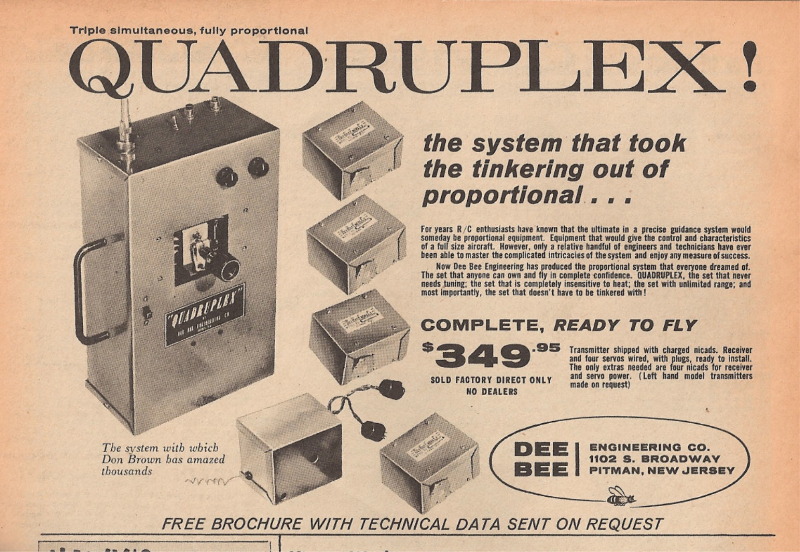
Here is the first Quadruplex advertisement (Oct, 62 AM), the product roll-out announcement (Sept 62, M.A.N) and the larger 3rd advertisement (Dec 62, M.A.N). The transmitter pictured in all three of these is the prototype now resting regally in The Radio Control Hall of Fame®. This picture continued to be used in all ads through at least April 1963. Beginning around June, 1963 the ads began to picture a production model –gray case, orange oval decals and none of the nine eccentricities discussed below.
Hard to believe the crucial introductory ads used photos of a hand-made, raw aluminum prototype, but they don’t look bad at all. The finish and general condition of this transmitter would naturally have been much better back then before many decades of additional use, modification and storage.
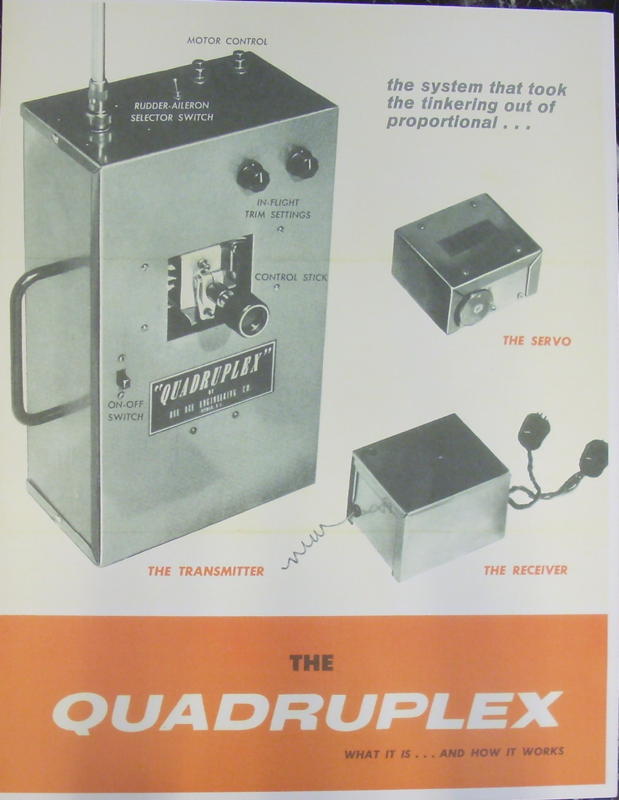
As it appears today, the prototype transmitter is different from the first ad in three respects. On its face it has a black charging jack plus one additional (slightly larger) screw to hold a voltage reducer. Quadruplex chief engineer, Carl Schwab, has confirmed that these were retrofits installed at a later date. After discussions with Don Brown it appears the handle, and perhaps the back of the case, were also changed later and the Quadruplex label was applied just before the Ad to help make it look more like a finished product. Finally, the black coloring on the Quadruplex label came off some time ago (probably during cleaning), but every letter on it is still plainly visible upon close examination, and this label is identical to that appearing on the very earliest production units.
Aside from the retrofit charging jack, extra screw and handle and the label’s loss of color, this prototype is exactly like the transmitter pictured in the first ad. Any remaining doubt dissolves when you see that each of the nine external peculiarities of the prototype are also visible on the transmitter in the ad, and not on any production models. Can you find the nine unique details which demonstrate this is the transmitter in the famous ad? Clue: The first is the presence of four additional screws on the top of the case to hold an antenna mount reinforcement inside, and the second is the way the four screws were (hand) mounted off-center at a slight angle to the edge of the case.
Magazine Mention
In the July/August 1965 edition, American Modeler published a biographical account entitled “Don Brown, the Radio Man: Quad Tycoon”. This article recounts how Carl Schwab designed the transmitter and receiver to go with Don Brown’s already successful servos. The article mentioned that Don built this prototype and early production models in the cellar of his house to avoid interfering with his radio and TV business, and gave further details:
“The first production prototype Quadruplex was flown in Don’s Ambassador (essentially a “cleaned-up” DB-4). Though completely handmade, it was exactly the same as the units put into production and this first hand-held model is still being flown by Joe Windfelder. Don feels a sentimental attachment to this pioneer outfit, lets Joe fly it on long-term loan, to see just how many flights may be extracted from this one outfit. The same equipment and plane were flown in England in summer 1962 and brought Don 5th at the FAI R/C Internationals.”
Link to Quadruplex Company History
