


Special Exhibit:
Orbit Elite
(Click on any of the images on this page to see a larger version)
In late 1974 through early 1975, rumors of Super Radios swirled throughout the RC Community. Word was that several manufacturers would soon offer high-end systems beyond anything ever before produced. The rumors were true.
Through the industry grapevine, Orbit learned before the public about Kraft’s grand plan to produce a super radio. This news jolted Orbit into action, and they embarked on a crash program to develop their own super radio to stay competitive. Since Kraft had a head- start, Orbit personnel had to work harder, sometimes around the clock. They ended up beating Kraft to market by 1 month.
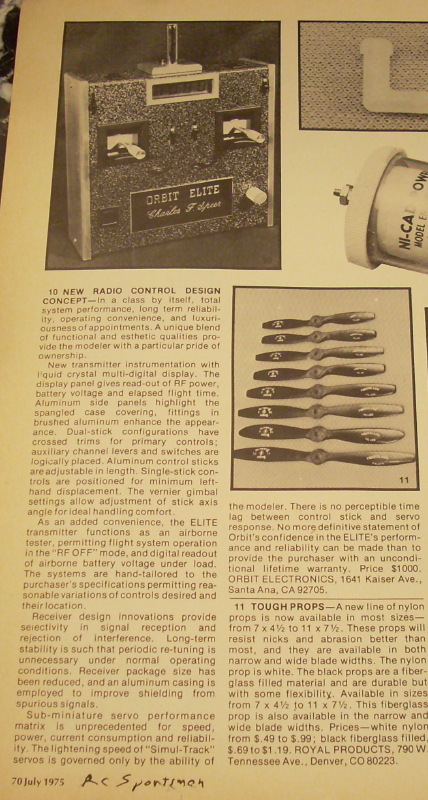
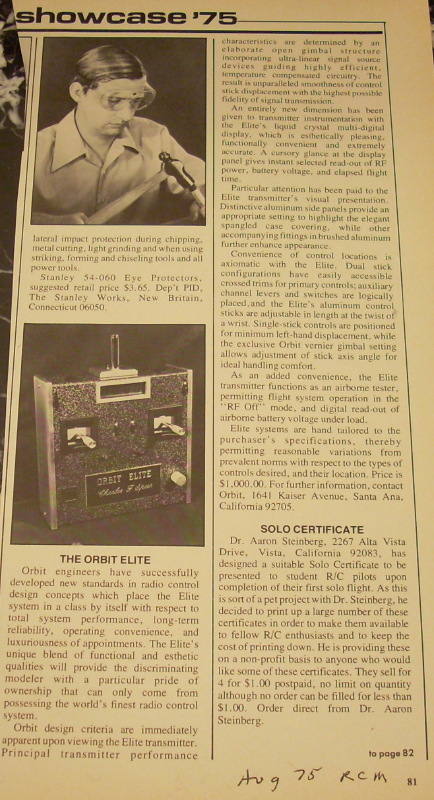
The Orbit Elite was designed by Chief Engineer Dick Dunham and his assistant, Jim Burlile. They drew up plans for a super system to sell for $1,000 and beat the Signature series by having even more advanced features and a lot of “flash” to make it more physically attractive. Top management, unfortunately, overruled many of these advances as too costly and complex.
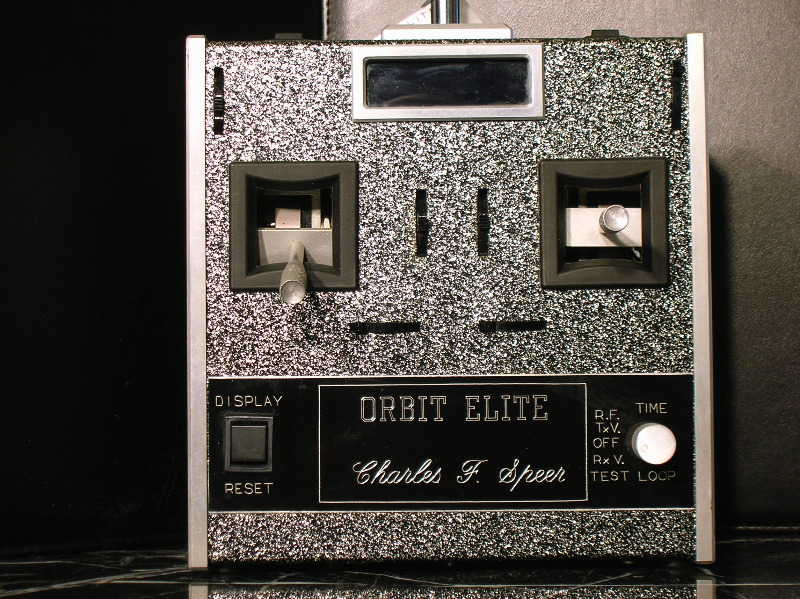
Over the course of design, many advanced features such as dual rates servo reversing, end point control and mixing were dropped but the “glitz” remained. Instead of Orbit’s normal black vinyl, the transmitter was covered with a dazzling chrome and black metal fleck finish. It also incorporated a liquid crystal display; as far as we know this was the first RC transmitter to have an LCD and it would be many years before they became common.
This display panel, among other things, provided vital information about elapsed flight time, RF power, transmitter battery level and even the battery level of the airborne system. Evidently the airborne power read-out was done only while the aircraft was on the ground.
The LCD had 7 settings:
1.) Loop 2.) Test 3.) RxV 4.) Off 5.) TxV 6.) RF and 7.) Time. Engineer Jim Burlile still recalls the effort to use the highest quality parts available at the time:
“We opted for Spectrol conductive plastic pots for the gimbals, Bourns plastic pots for trims and Mil spec parts for everything else in the radio. ****It had a plugin RF module in the Tx, the Rx was much like a ProLine with 2 boards, the Rf section and the decoder, with the servo motors being replaced with Escap coreless motors. It also had a liquid crystal display for all meter functions. It also had an upgraded metal open gimble that was made by a guy named George Prather, he is also the guy who made the stick knobs that were adjustable. They were made slightly eccentric inside so you could twist them to loosen it and adjust the length then twist to tighten again.”
You can appreciate how the Elite sparkles by viewing it with hundreds of other radios on our home page Virtual Tour. This panoramic presentation was produced by a rocket scientist at NASA’s Houston Center. He used the same camera and lighting for the Elite as for all the others, and photographed it at the same time, but look at the difference.
Note that the radio pictured in the product announcement had a smaller name plate subsequently enlarged to be more attractive and include switch labeling. You can also see the “1,000” on the LCD which Orbit’s “Big John” Elliot entered at a trade show to impress modelers with its price. One thousand dollars in 1975 is equivalent to $4,000 in 2009! For this price, the Elite offered one of the most, if not THE most, advanced and attractive system in the world. Orbit also extended an unconditional lifetime warranty. This would have been of little value, it turned out, since the company went out of business just 4 months after the product announcements.
Orbit may have had a naming contest for this system to generate interest and publicity. Ultimately the name “Elite” was selected by Orbit’s then-President, Charles Speer. Years later these Prather gimbels and sticks were used on other high-end, top-of-the-line systems including the Logictrol Championship Series and Milcott Specialist. The system was never produced, however, as Orbit’s fortunes declined throughout 1975. At 11am on Christmas Eve, December 24, 1975 Orbit employees received a surprise notice that the company was closing and everyone was laid off.
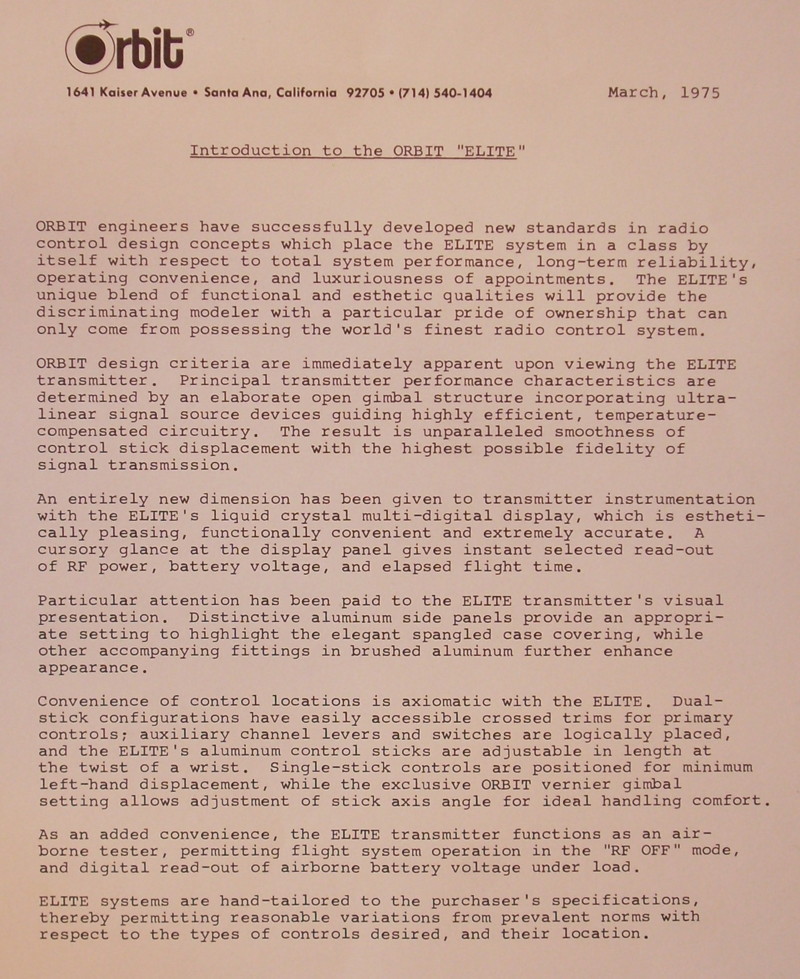
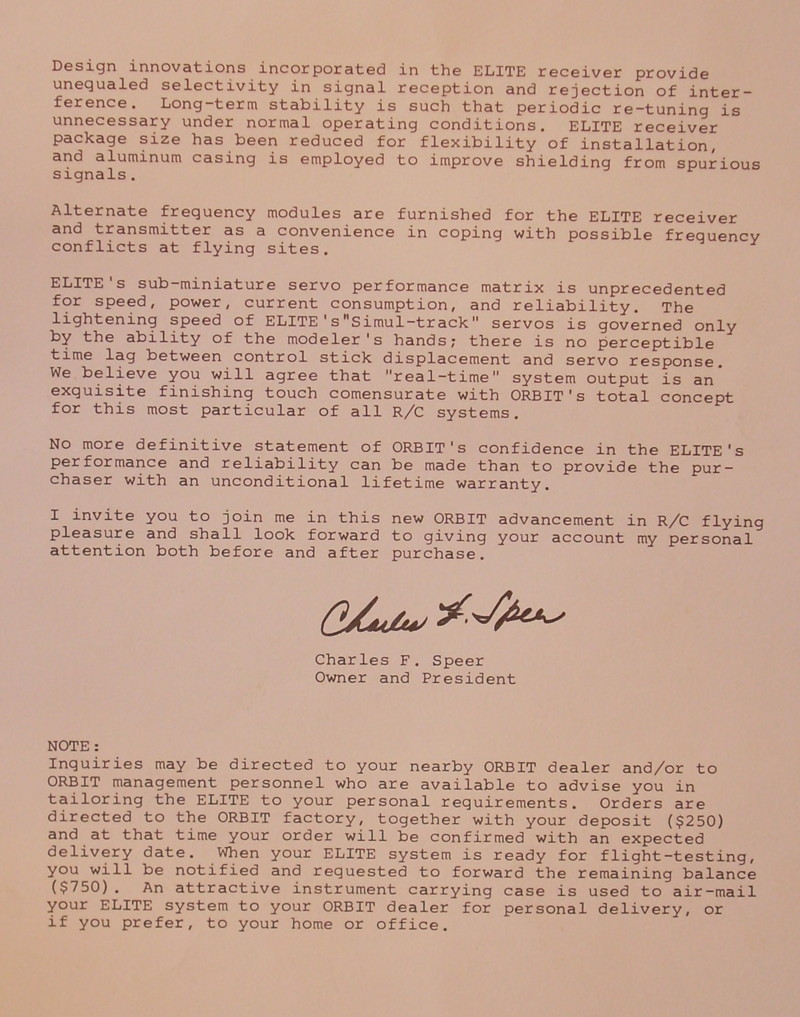
Here is Speer's letter announcing the Orbit Elite, which was inserted in all of Orbit's final catalogs:
 |  |
Orbit was one of the most recognized names in the developmental era of RC history. Its radios were once used by more competitors in more countries than any other brand. The Elite was the most advanced radio ever produced by this famous company (although when it closed, Jim Burlile and others there were well along on still more sophisticated systems).
Orbit saved its best for last, adding this final, shining accomplishment to its long line of quality products just months before the end. But as superior as the Elite was, it came too late to save Orbit from its fate. This was similar to the wonder weapons which appeared at the end of World War II—clearly superior but unable to change the course of the war.
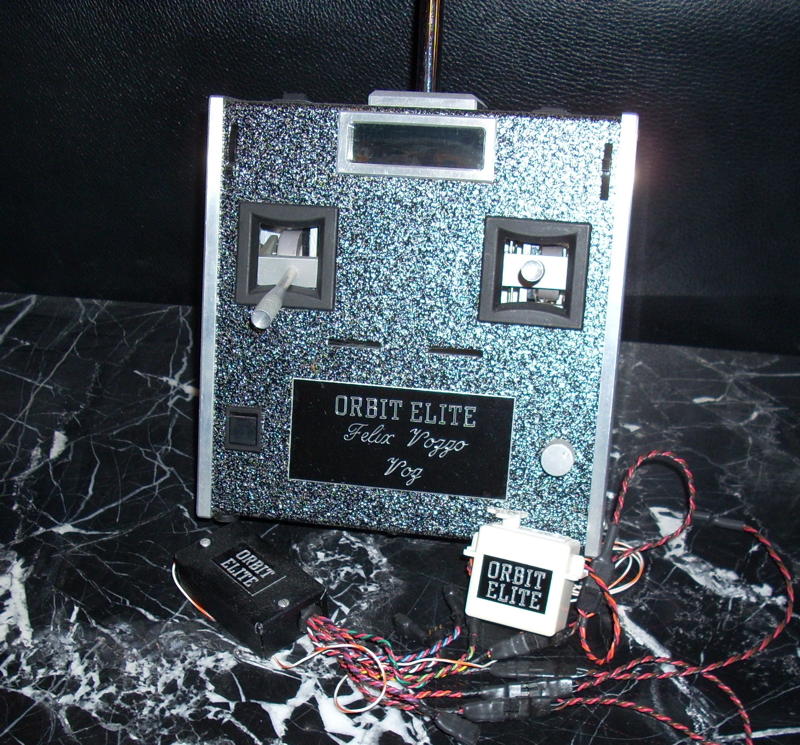
Despite an influx of orders in the final days, only two complete Orbit Elite transmitters were ever made. We recently acquired the second one, along with an Orbit Elite receiver and servo.
The Orbit Elite.
